Lab members Stella Shen, Rebecca Bell and Sarah Schillinger presented their work at the Meeting on Language in Autism, 2026.
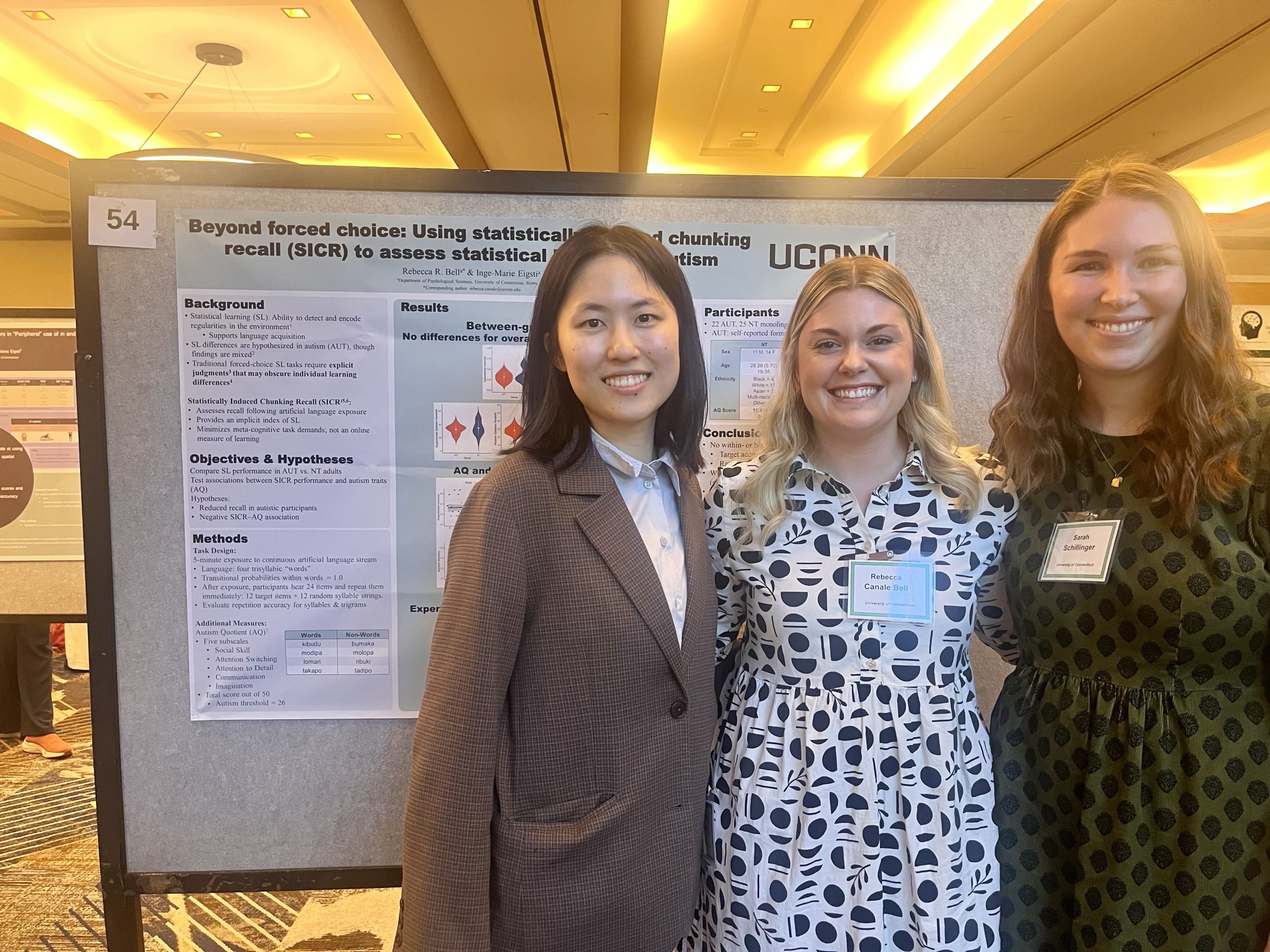
Lab members Stella Shen, Rebecca Bell and Sarah Schillinger presented their work at the Meeting on Language in Autism, 2026.
Dr. Girolamo was chosen as a recipient of the ASHA Early Career Contributions to Research Award! We are so proud of Teresa, former post-doc in the CALL lab.
Crutcher, J., Butler, E., Burke, J. D., Naigles, L., Fein, D. A., & Eigsti, I. M. (in press). Pragmatic language and associations with externalizing behaviors in individuals with autism spectrum disorder (ASD) and those who have lost the ASD diagnosis. Research in Autism Spectrum Disorders.
Congrats to post-doctoral fellow Teresa Girolamo on her new position at San Diego State University, and her multiple recent publications:
Girolamo, T., Castro, N., Hendricks, A. E., Ghali, S., & Eigsti, I. M. (2022). Implementation of Open Science Practices in Communication Sciences and Disorders Research With Black, Indigenous, and People of Color. Journal of Speech, Language, and Hearing Research, 1-8. https://doi.org/10.1044/2022_jslhr-22-00272
Girolamo, T., Parker, T., & Eigsti, I. M. (2022). Incorporating DisCrit theory to combat systematic exclusion of BIPOC in clinical neuroscience. Frontiers in Human Neuroscience. https://doi.org/10.3389/fnins.2022.988092
Girolamo, T., Ghali, S., & Eigsti, I. M. (2023). A community-based approach to longitudinal language research with racially and ethnically minoritized autistic young adults: Lessons learned and new directions. American Journal of Speech and Language Pathology, 32(3), 977-988. https://doi.org/10.1044/2023_ajslp-22-00341
Girolamo, T., Shen, L., Gulick, A., Rice, M. L., & Eigsti, I. M. (in press). Studies pertaining to language impairment in school-age autistic individuals underreport participant sociodemographics: A systematic review. Autism.
We are delighted to share a new publication, describing the Low Verbal Investigatory Screener (LVIS). We hope that this measure will prove useful to the broader community!
Naples*, Tenenbaum*, Jones, Righi, Sheinkopf & Eigsti (in press). Exploring communicative competence in autistic children who are minimally verbal: The Low Verbal Investigatory Survey for Autism (LVIS). Autism. *First and second author made equal contributions.
And learn more about the LVIS here:
https://sparkforautism.org/discover_article/stigma-autism/
After graduating from UConn, Amanda is now working in the Advanced Baby Imaging Lab in Rhode Island (Deoni, PI), traveling to Kenya, Ghana and Zambia with a portable MRI system. Way to go, Amanda!
Eigsti, I. M., & Irvine, C. (in press). Verbal mediation of theory of mind in verbal adolescents with autism spectrum disorder. Language Acquisition.
Abstract. Beyond the symptoms which characterize their diagnoses, individuals with autism spectrum disorder (ASD) show enhanced performance in simple perceptual discrimination tasks. Often attributed to superior sensory sensitivities, enhanced performance may also reflect a weaker bias towards previously perceived stimuli. This study probes perceptual inference in a group of individuals who have lost the autism diagnosis (LAD); that is, they were diagnosed with ASD in early childhood but have no current ASD symptoms. Groups of LAD, current ASD, and typically developing (TD) participants completed an auditory discrimination task. Individuals with TD showed a bias towards previously perceived stimuli—a perceptual process called “contraction bias”; that is, their representation of a given tone was contracted towards the preceding trial stimulus in a manner that is Bayesian optimal. Similarly, individuals in the LAD group showed a contraction bias. In contrast, individuals with current ASD showed a weaker contraction bias, suggesting reduced perceptual inferencing. These findings suggest that changes that characterize LAD extend beyond the social and communicative symptoms of ASD, impacting perceptual domains. Measuring perceptual processing earlier in development in ASD will tap the causality between changes in perceptual and symptomatological domains. Further, the characterization of perceptual inference could reveal meaningful individual differences in complex high-level behaviors.